News:

June 19, 2025
Students of the Mampong Senior High Technical School for the deaf have appealed for a dedicated legislative framework for deaf education in Ghana as currently the only institution which is theirs functions with a law that secures its future through guaranteed funding policy direction and institutional support.
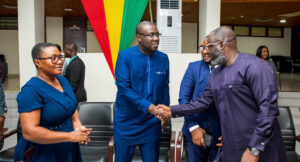
This came to light when the department of public engagement of Parliament House and Akuapem North lawmaker Samuel Awuku engaged the students and featured some lawmakers like Hon. Fred Agbenyo, Hon. Edem Agbana, Hon. Kojo Oppong Nkrumah, Hon. Shirley Kyei, and Hon. Wallace Pele.
The absence of the formal legislation leaves the school vulnerable to inconsistent budgetary allocations, administrative neglect, and limited infrastructural development.
In the statement on the floor of the House, the Akuapem North lawmaker on Wednesday, June 18, 2025 noted that legislation would do more than fund a school; it would serve as a national commitment to inclusivity, equity, and sustainable educational development for a marginalised group of our population, in accordance with Sustainable Development Goal (SDG) 4 (Quality Education): Target 4.5 which aims to eliminate gender disparities in education and ensure equal access to all levels of education and vocational training for vulnerable groups, including people with disabilities, indigenous people, and children in vulnerable situations, by 2030.
Mr. Awuku further pointed out that the school, currently operates from two physically separated campuses – North and South.
This setup forces students to cross busy roads several times a day, risking their lives just to access food or attend classes.
Furthermore, students depend on taxis to transport food between the campuses, and this unreliable system has often resulted in delays, and in some cases, complete failure to deliver meals, thereby affecting student nutrition and concentration. An on-site dining hall is recommended to ensure nutrition and eliminate reliance on external logistics.
“Mr. Speaker, the recommendation for a centralised and accessible learning environment, complete with an on-site dining facility, must be taken up by the Ministry of Education with support from Parliament”.
Thirdly, while the inadequacy of the current national curriculum in addressing the needs of deaf learners, teachers explained that, most lessons have to be repeated multiple times due to comprehension delays, and that current assessment structures do not account forthe unique learning methods required by hearing-impaired students.
As such, the students proposed a comprehensive review of the National Curriculum for Deaf Learners to incorporate:
Sign language-based instructional materials;
Visual learning tools;
Simplified content structures.
Extended teaching and assessment time.
Additionally, they recommended the recruitment and training of more sign language interpreters, the provision of learning aids, and specialised professional development for teachers in deaf education.
And recommended that, Parliament must take steps to ensure that inclusive education becomes a practical reality rather than a theoretical aspiration. We must empower and urge the Ghana Education Service to work with curriculum experts and disability advocates to revise content, pedagogy, and assessment methods.
Again, another area of concern was the systemic exclusion of deaf individuals from Ghana’s justice system. Deaf persons have encounter difficulties in attempting to report crimes, defend themselves, or pursue justice due to the absence of trained interpreters at police stations and in courtrooms.
Kwaku Sakyi-Danso/Ghanamps.com