News:
February 24, 2026
After decades of fruitless attempts to launch a single currency (the “ECO”) for the West African sub-region, a key official of the ECOWAS Parliament is advocating for a pragmatic pivot to digital payment systems to achieve real economic integration.
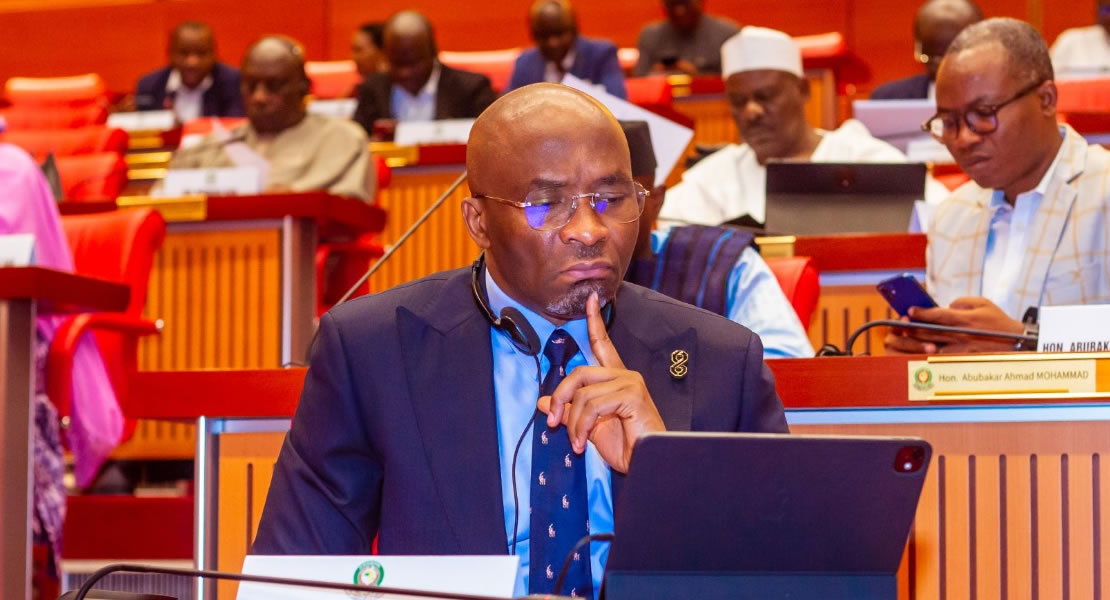
Benjamin Kalu, Chairman of the Finance, Administration and Budget Committee of the Economic Community of West African States (ECOWAS) Parliament, argued that the bloc must abandon its long-held ambition for a physical common currency in favor of leveraging existing technology.
According to Kalu, who is also the Deputy Speaker of Nigeria’s House of Representatives, the relentless pursuit of macroeconomic convergence for a single currency has proven to be an elusive goal. “If you ask me, total economic market convergence for a single currency is a 20th-century mirage,” he stated. “We need to strategically redirect our energy toward the Pan-African Payment and Settlement System (PAPSS).”
He made the remarks on Monday, February 23, 2026, in Abuja during the ECOWAS Parliament’s First Extraordinary Session and parliamentary seminar. The event is themed, “Deepening regional integration through the African Continental Free Trade Area (AfCFTA): opportunities and challenges for expanding intra-community trade within the ECOWAS region.”
Kalu emphasized that the sub-region bleeds billions of dollars annually due to its reliance on the US dollar for intra-community transactions. He championed PAPSS as the solution to this financial drain, noting that it would facilitate instant settlements in local currencies without compromising national sovereignty.
“Why should the sub-region wait in perpetuity for a shared banknote when we can solve the problem today with a digital switch?” Kalu questioned his colleagues on the floor of the parliament. “Let us stop debating whose face goes on a currency that does not exist and start connecting central banks to systems that are already in place to work. The dollar dependency costs us about five billion dollars annually in transactional fees.”
Kalu stressed that this digital shift must be prioritized alongside practical initiatives like the Guided Trade Initiative (GTI) to make the AfCFTA a tangible reality for businesses and individuals across the region. “We need to make the AfCFTA a reality for the manufacturer in the backyard of his state, the agro-processor in Ivory Coast, and the small-scale trader in The Gambia,” he said.
Drawing from his international engagements, Kalu recounted a recent visit to the European Parliament. “I spent seven days with them last year. They invited me to discuss how they can relate with Africa better,” he shared. “What I told them is that we are tired of aid. If we want to relate economically, that is our priority.”
He urged a fundamental shift in the continent’s economic partnerships, moving away from being mere exporters of raw materials. “We need to adopt economic principles that attract finance and technology closer to our raw materials,” Kalu argued.
He illustrated his point by questioning the logic of current trade patterns within Africa. “If the ECOWAS sub-region knows Ivory Coast for cocoa, does that mean Nigeria does not have cocoa? If we are talking about an Africa trade agreement, is Nigeria going to trade cocoa for cocoa with Ivory Coast? What is better is to use technology from other countries to convert our cocoa to chocolate; then I can trade the chocolate for the cocoa of Ivory Coast.”
He applied the same logic to other resources. “Ghana has gold, Nigeria has gold. If I give gold for gold, what benefit is it? Rather, I should bring in a processing plant that would convert Nigeria’s gold into jewelry, then I can trade my jewelry for the gold of Ghana. Let us collaborate with one another and benefit from it.”
Kalu concluded that by prioritizing value addition and leveraging digital financial infrastructure like PAPSS, the region can finally unlock the benefits of the AfCFTA and foster genuine, mutually beneficial economic integration.
Kwaku Sakyi-Danso/Ghanamps.com