News:
August 18, 2026
Ghana’s Minority Leader, Alexander Kwamena Afenyo-Markin, has accused the Ghana Gold Board (GoldBod) of causing financial loss to the state to the tune of GH¢22 billion, vowing to push for parliamentary scrutiny despite attacks from the institution’s management.
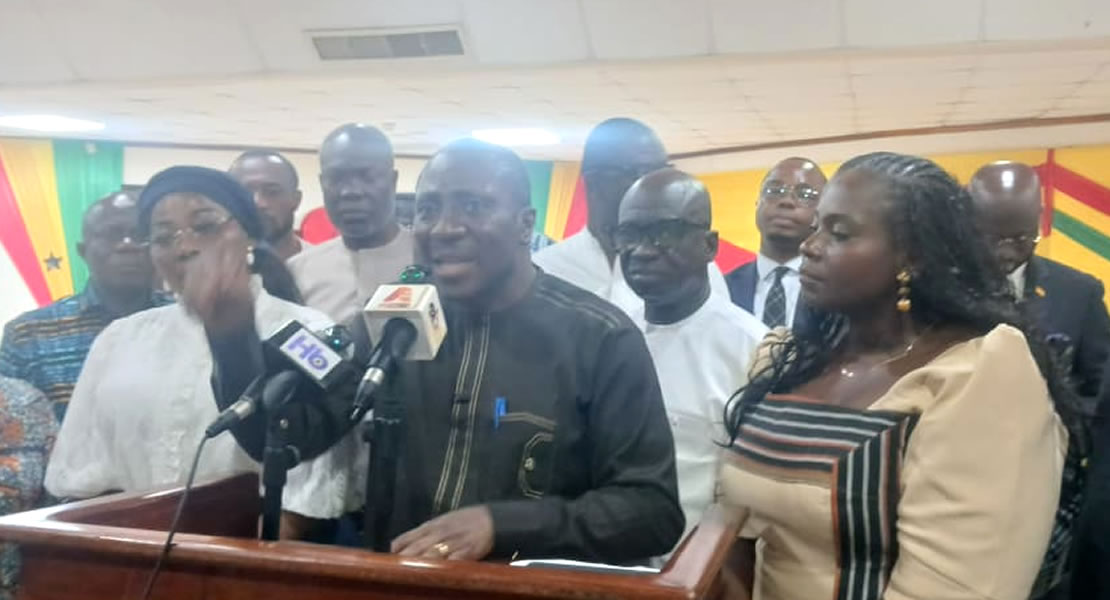
Speaking at a press conference in Parliament on Tuesday, Afenyo-Markin said the Minority would file a motion to compel GoldBod management to account for the losses once Parliament resumes. He appealed to Majority lawmakers not to use their supermajority to block the motion.
“You don’t trade in gold and make losses. No serious institution loses this much money by accident,” Afenyo-Markin said. “This is what happens when an untouchable few are handed Ghana’s gold with no one watching and no one willing to ask questions”.
IMF Report Cited as Evidence
The Minority Leader cited an International Monetary Fund (IMF) assessment indicating that the gold purchase programme had led to GH¢22 billion in losses. According to the IMF’s Country Report No. 26/213, losses from the programme in 2025 exceeded US$1.7 billion, equivalent to about 1.5% of Ghana’s Gross Domestic Product.
The IMF said the Bank of Ghana’s domestic gold-buying scheme, run in tandem with GoldBod, racked up losses of GH¢22 billion — equivalent to 1.5% of GDP — in a single year. The disclosure marks a steep escalation from the US$214 million loss the IMF first flagged in December 2025.
“The IMF tells us that 17% of the value of every ounce of gold sold by the Bank of Ghana simply disappeared. It vanished through the rate paid to miners and the rate used in the books,” Afenyo-Markin said. “This is a structural bleeding of our national purse”.
GoldBod: Using Bank of Ghana as ‘Alter Ego’
Afenyo-Markin argued that GoldBod is using the Bank of Ghana as an “alter ego” to evade accountability. “If one state institution is responsible for buying, aggregating, assaying, and exporting gold and another state institution supplies the capital and bears virtually all the downside, Parliament is entitled to ask whether the risk allocation is prudent,” he said.
He also raised concerns about GoldBod’s dual role as both regulator and buyer of gold from small-scale miners. According to him, aggregators were initially paid a 15% fee, which was later reduced to 9% and then to 5% after the Minority raised concerns.
GoldBod Rejects Allegations
GoldBod Chief Executive Officer Sammy Gyamfi has firmly rejected claims of a GH¢22 billion loss, describing the allegations as false. He pointed to the institution’s audited 2025 financial statements, which recorded an operational surplus of GH¢907 million and an overall surplus of GH¢5.4 billion.
Gyamfi had earlier described the Minority Leader’s claims as “a blatant lie” based on what he termed the “hallucinatory imagination” of Afenyo-Markin.
Escalating Dispute
The conflicting claims have intensified calls for greater scrutiny of GoldBod’s financial records and operations. Afenyo-Markin warned that those found responsible for any wrongdoing would eventually be required to answer for their actions.
“GoldBod is a very big scandal awaiting us. There are things we know that they don’t know. They should be careful,” he had warned earlier.
The IMF has cautioned that state involvement in gold buying remains a liability, noting that the programme will continue to pose a fiscal risk as long as state-led domestic gold purchases continue. The Fund said containing GoldBod’s costs is now central to limiting those risks.
Ghanamps.com