News:
September 29, 2026
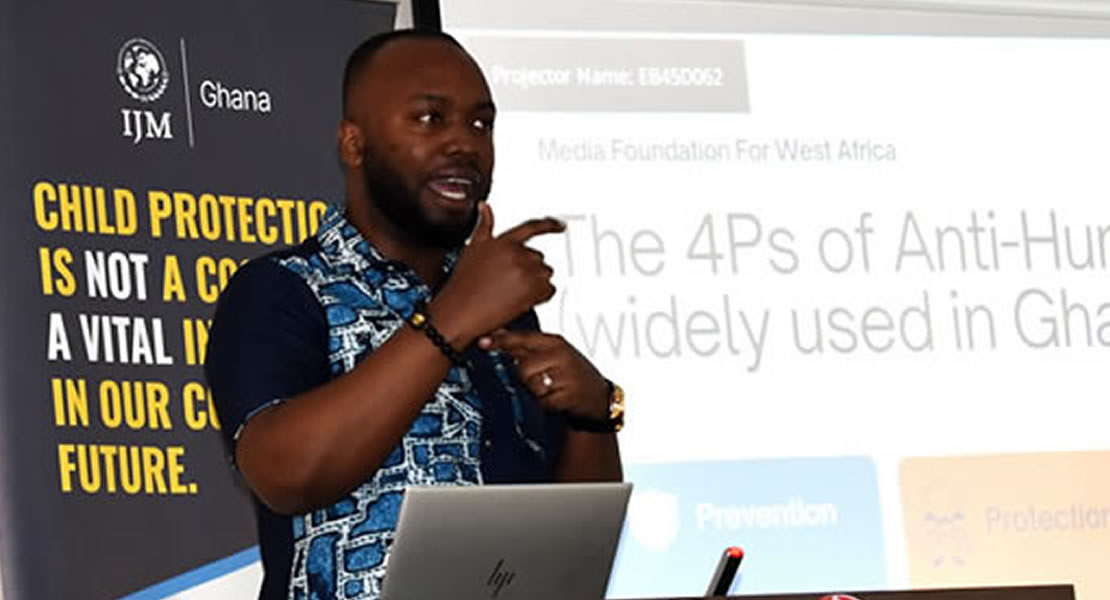
A one-day training on Child Protection, Human Trafficking and Policy Advocacy has renewed calls for Ghana to adequately resource social protection institutions and ensure effective investigations into trafficking and child exploitation.
The training was organised by the African Centre for Parliamentary Affairs (ACEPA) in collaboration with International Justice Mission (IJM) Ghana on Monday, 28 September 2026.
Ernest Kojo Manu, Communications Specialist at IJM Ghana, said Ghana’s National Plan of Action on Human Trafficking requires stronger government commitment, improved institutional capacity, adequate funding and better protection for victims and survivors. He said the plan, which provides for training officials and strengthening institutions, is under review and offers an opportunity to address gaps in the country’s response.
Mr Manu urged journalists, particularly those covering Parliament, to monitor the review process and any subsequent legislative action. He said proposed reforms must close existing loopholes in the fight against human trafficking and child exploitation.
He raised particular concern about the Department of Social Welfare, saying some personnel recruited into the department are not qualified social workers. That gap, he warned, could affect the quality of services provided to vulnerable children, and NGOs cannot solve it because recruitment is a government responsibility.
He also said Ghana’s Human Trafficking Act, enacted about 20 years ago, needs amendment to reflect emerging challenges. He disclosed that the Gender Ministry had indicated the amendment process would begin, with proposed changes expected before Parliament, and urged journalists to scrutinise them.
On the Children’s Act, Mr Manu cautioned against any reduction in the minimum age for work without careful examination. He said lowering the threshold could expose children to exploitation, especially in sectors such as cocoa production.
Funding was another major concern. Mr Manu said GH¢1 million was allocated to the Human Trafficking Fund last year, but it was reduced to GH¢500,000 at mid-year review, with only GH¢250,000 actually disbursed. Advocacy later restored the allocation to GH¢1 million this year, and he urged the media to track annual reports on allocations, disbursements and benefits received by survivors.
Lawyer Nana Efua Nyamekye Amanfu said understanding Ghana’s legal framework is essential for identifying trafficking cases, conducting effective investigations and protecting victims, especially children. She explained that trafficking has three elements—the act, the means and the purpose—and that actual exploitation does not necessarily have to occur before an offence is established.
Amanfu urged investigators to look beyond statements from suspected traffickers and gather evidence from victims, drivers, border officials, landlords and others who may know about recruitment or movement. She said investigators must establish the acts involved, the means used and the intended purpose of exploitation.
She also clarified that trafficking does not require movement across international borders, noting that short-distance transfer, harbouring, training or receiving a person for exploitation can fall under the law. She stressed that under Section 4 of the Human Trafficking Act, consent cannot be used as a defence in child trafficking prosecutions in circumstances covered by the provision, and urged journalists and stakeholders to understand the law so cases are accurately identified, investigated and reported.
Ghanamps.com