News:

May 13, 2026
Dr. Abdel-Fatau Musah says an elected legislature is essential for a vibrant West African integration – and suggests a 2030 target.
As momentum builds to transform the ECOWAS Parliament from an advisory body into a legislature with binding powers, the bloc’s Commissioner for Political Affairs, Peace and Security has made a clear demand: members must be chosen through free and fair elections.
Speaking on Tuesday, May 12, 2026, while presenting the outcome of regional consultations ahead of a special summit on the future of West African integration, Ambassador Dr. Abdel-Fatau Musah stressed that the current model falls short.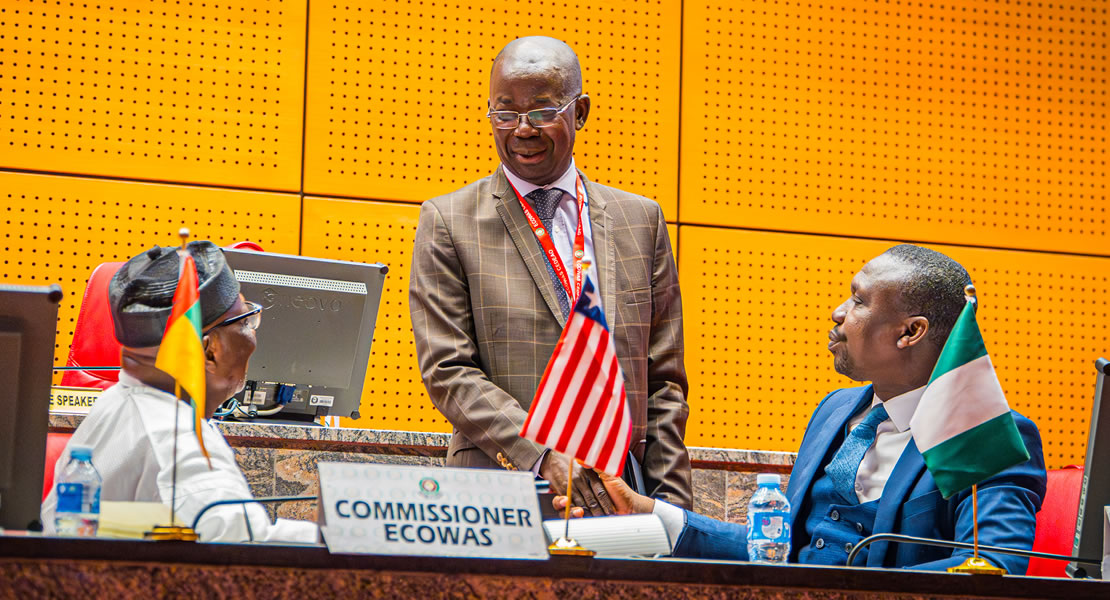
“We need to work together to ensure that the ECOWAS Parliament is not only advisory in its role – it is able to elect its members,” he said.
The remarks come as some MPs have voiced frustration over the chamber’s limited influence, even as the push to give it “teeth to bite” intensifies.
Parliament already taking steps, says Fourth Deputy Speaker
Billy G. Tunkara, Fourth Deputy Speaker and chair of an Ad Hoc Committee set up by the Rt. Hon. Speaker to explore the election of MPs, noted that the Parliament has already begun putting mechanisms in place.
Commissioner Musah outlined three core functions of any effective parliament: oversight, legislation, and parliamentary diplomacy. He argued that these are especially critical for representing the citizens of the Community.
“Let us make sure that MPs come to the Community Parliament through free and fair elections, standing on principles and ideological platforms,” he said. “That is what we see in many other blocs. MPs do not come to parliament to defend their member states.”
EU comparison and 2030 goal
Musah pointed to the European Parliament as an example, where members typically align with ideological groups – such as Greens focused on the environment, or left- and right-wing blocs – rather than defending national interests.
“You would hardly see a parliamentary bloc defending a member state,” he noted. “We should be able to have that. If we can achieve that by 2030, that will be fantastic.”
Court rulings and sanctions
The Commissioner also raised concerns about the ECOWAS Community Court of Justice, whose decisions are supposed to be binding on member states – but often are not.
“How do we ensure that? Is it through sanctions? These are some of the creative ways we have to think about it,” Musah said. “I cannot see the region being vibrant and forward-looking without an effective parliament. This is what we all have to fight for, all together.”
Kwaku Sakyi-Danso / Ghanamps.com